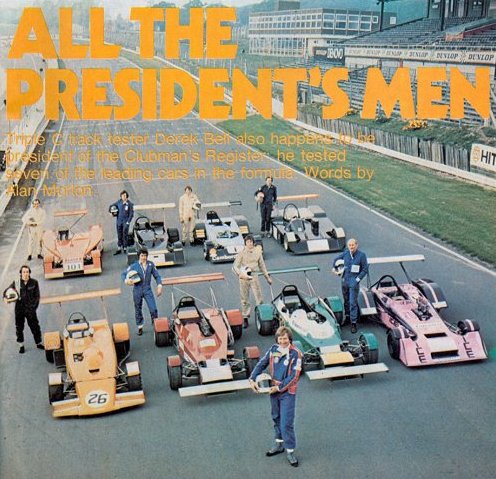
All The President's Men
by Alan Morton
Reprinted from Car & Car Conversions,
January 1978.
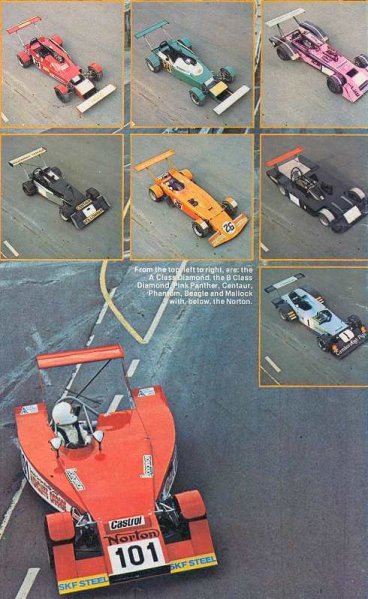 The
cars are basically allowed to have any modification to the mechanicals.
These cars often record faster lap times than F3 cars round many British
circuits, and Derek got a shock when he found himself doing lap times
round Brands only four seconds slower than he did in the Hexagon Penske
ex- F1 car !
The
cars are basically allowed to have any modification to the mechanicals.
These cars often record faster lap times than F3 cars round many British
circuits, and Derek got a shock when he found himself doing lap times
round Brands only four seconds slower than he did in the Hexagon Penske
ex- F1 car !He had various trials and tribulations with the cars but by the end of the day we both had a clear impression of what Clubmans is all about. Everyone was jolly and humour was rife (what can you expect from people who call their cars silly names like Pink Panther ?).
Derek's comments were straight from the shoulder; that's what they wanted because all the teams realised they weren't professionals and didn't try to pretend they were. For example, after Derek's praise, Tony Norton admitted that the only reason he had put a rear wing on the car was because his wife told him it would look silly without one !
Jim Yardley kept quiet about the fact that his steering wheel moved towards you under braking and Derek wasn't sure whether that was better than the offset steering wheel in the Panther or not! He was sure he preferred brakes though, as one team kindly fitted new pads but didn't have time to bed them in properly, resulting in Mr Bell approaching Druids rather rapidly.
He said. "The last time I was here I ran an F1 car into the bank at Druids and I can still see the red mark. I didn't want to end up there again."
"Overall though, the cars are tremendously well built and I have the greatest admiration for people who can construct cars to such a high standard with little or no technical training. A lot of good ideas have gone into them and they are very fast and competitive cars."
"They have improved a hell of a lot since I first tested them two seasons ago, but funnily enough, I wasn't surprised at how quick they were. I couldn't believe it the first time I drove them, but this year I suppose, I had built myself up to expect lots of speed."
"My only overall judgement is that they are getting too tied up with things that don't matter (like aerodynamics), when they haven't sorted out the basics of the car. They end up getting confused and developing in the wrong direction. Even so, their efforts are remarkable and I enjoyed myself a hell of a lot." Clubmans people being the types they are, I don't think he could have failed to do that !
 Jim
Yardley is a successful club driver, designer, and constructor, and
this looks like being another successful car. His Mk1 Beagle won the
Monoposto Championship in 1969, and his Mklll did well in the same series
until converted to Clubman's in '76. The MkIV is a development but is
specifically designed for Clubman's this time. It was only brought out
in August but has managed a third place at Cadwell and a shared fastest
lap when holding second place at Croft, in its first five races.
Jim
Yardley is a successful club driver, designer, and constructor, and
this looks like being another successful car. His Mk1 Beagle won the
Monoposto Championship in 1969, and his Mklll did well in the same series
until converted to Clubman's in '76. The MkIV is a development but is
specifically designed for Clubman's this time. It was only brought out
in August but has managed a third place at Cadwell and a shared fastest
lap when holding second place at Croft, in its first five races.
The car's suspension features tubular spaceframe beam "axles"
which are located by a Panhard rod and parallel radius arms. Front hubs
and uprights are from the DNI Formula I Shadow. Rear magnesium uprights
are Palliser with Brabham hubs. The engine, which has given a little
trouble, uses twin 441DF Webers, a Cosworth FVA crankshaft and a Cosworth
A8 camshaft. The gearbox consists of Ford 2000E ratios in a magnesium
case, with a special aluminium rear housing that leads to the VW transaxle
casing containing two Hewland drop gears.
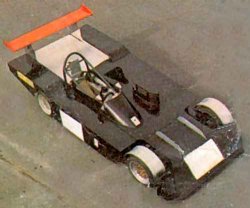
 What
a combination, beauty and the beast though no-one is quite sure which
is which. This partnership combines the talents shall we say, of two
of the leading characters, for want of a better description, that exist
in Clubmans racing today. Peter Deal is the epitomy of experience. He
was racing regularly when Derek Bell first started !
What
a combination, beauty and the beast though no-one is quite sure which
is which. This partnership combines the talents shall we say, of two
of the leading characters, for want of a better description, that exist
in Clubmans racing today. Peter Deal is the epitomy of experience. He
was racing regularly when Derek Bell first started !
Fickle fate has entwined his career with the go-getting Stuart Glass who has recognised his own driving talents and appointed himself Secretary of the Clubmans Register.
Fortunately, the work keeps him out of the way most of the time and Peter can get on with driving.
The original car which started the season was loosely based on a Gryphon, and became even more loosely based when demolished by sleepers in May. The car was rebuilt around a secondhand chassis and Peter has not been too happy with it since its reappearance in July.
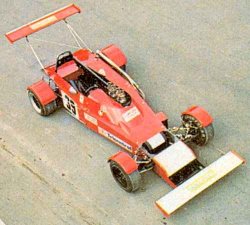 Andy
Diamond is an ex-Gryphon designer, and now he hopes he has come up with
a replacement. The Gryphon was the staple diet of Clubmen up to a couple
of seasons ago, and now Andy hopes to produce a car which will be readily
available for anyone to do Clubmans but cheaper than the Mallocks.
Andy
Diamond is an ex-Gryphon designer, and now he hopes he has come up with
a replacement. The Gryphon was the staple diet of Clubmen up to a couple
of seasons ago, and now Andy hopes to produce a car which will be readily
available for anyone to do Clubmans but cheaper than the Mallocks.
He and Rauri Gilles built and tested the first car in July 1976, but were plagued with engine problems and lack of power in the three races that year.
This season they have still been developing but have managed two wins. In this car, the engine is ten inches further back to keep weight towards the rear. The standard BMC beam axle is held by parallel links; at the front, wishbones have been fabricated to keep the suspension as shallow as possible. There is an overall reduction in track to keep the car small and narrow. The front and rear wings help make the car very adjustable.
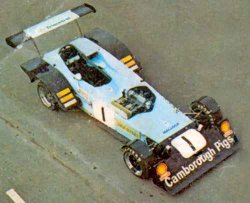 Mallock
and Clubmans are synonymous these days. You don't mention one without
the other. There's one good reason for that - the car keeps on winning.
Constant development has kept the car ahead of its opposition and bang
up to date. This is the works development car but has been run by Ardmore
Racing which is owned by Creighton Brown, a 39-yr-old farmer and garage
owner.
Mallock
and Clubmans are synonymous these days. You don't mention one without
the other. There's one good reason for that - the car keeps on winning.
Constant development has kept the car ahead of its opposition and bang
up to date. This is the works development car but has been run by Ardmore
Racing which is owned by Creighton Brown, a 39-yr-old farmer and garage
owner.
Creighton, a past Clubmans champion, had two wins this year while his driving partner, Alan Webb took four wins on his way to champion in the series for the second year running. Davina Galica and Ray Mallock have also run the car. It features a Mk 18b monocoque with a Cosworth-built engine, tuned by David Morgan, though Alan Webb maintains the car. The car features Watts linkage at the rear on a BMC beam axle and Mallock uprights at the front. The stiffer anti-roll bar has also helped in improving traction and turning-in this season.
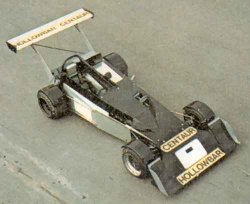 The
car was constructed by Richard Scott, but was first designed by David
Childs who is the current owner and regular driver. Richard Groombridge
has helped out with development.
The
car was constructed by Richard Scott, but was first designed by David
Childs who is the current owner and regular driver. Richard Groombridge
has helped out with development.
This Mk15 model has been built with economy in mind, because David wants to produce a car that is available complete or in parts for a very affordable price, thus bringing more people into Clubmans.
The car is simple to construct for the home-builder with the conventional BMC axle and Herald front uprights and steering rack. The car has stayed basically the same since the beginning of 1976 when it was first designed. Unfortunately, David has had little time on the track to actually develop it fully, and it still has the same Holbay engine he was using in 1971.
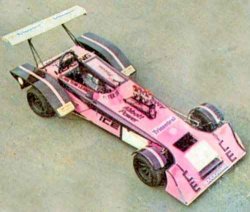
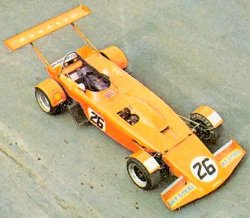 This
car, the third to be built with the Phantom tag, was designed by Chris
Greville-Smith and constructed with help from his mechanic Peter McCrea,
over a period of seven months.
This
car, the third to be built with the Phantom tag, was designed by Chris
Greville-Smith and constructed with help from his mechanic Peter McCrea,
over a period of seven months.
The car has a suspension unique to Clubman's racing, with a De Dion rear using inboard rear disc brakes.
Hollow Dural roll bar links and steering arms contribute to the lightness of the car, which weighs approximately 850lbs.
The car has been made even more competitive by changes to aerofoils, springs, roll bars, and more recently, with a change from Goodyear G54's to G50 tyres, Chris took pole and won first time out on these tyres. The engine is a long-stroke Swindon unit modified by Les Ryder, and has powered Chris to second in this year's championship. Originally this car was run as a Class 'B' version finishing second in the 1975 championship. Unfortunately, an engine disaster caused 1976 to be a bit of a "non-event".
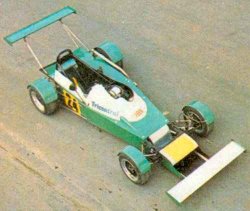 This
is the 'B' Class version of the Diamond marque. It is virtually identical
to the other, but has a smaller engine and one or two refinements that
its driver Peter Ludford has been trying.
This
is the 'B' Class version of the Diamond marque. It is virtually identical
to the other, but has a smaller engine and one or two refinements that
its driver Peter Ludford has been trying.
He works very closely with Andy Diamond in developing the car which has turned out to be very competitive.
This is another car that has had only a few races this season, and Peter freely admits that a lot of testing is still needed. Peter had a Gryphon before this which was "a superb car" though suffered with a poor engine. Now Peter has 100bhp under him and he is hoping for a successful season in '78.